Lennard Schulte, Krassimir P. Velikov
"What if food texture could be engineered not by adding ingredients, but by controlling the mechanical energy applied during processing of a natural plant fibre?
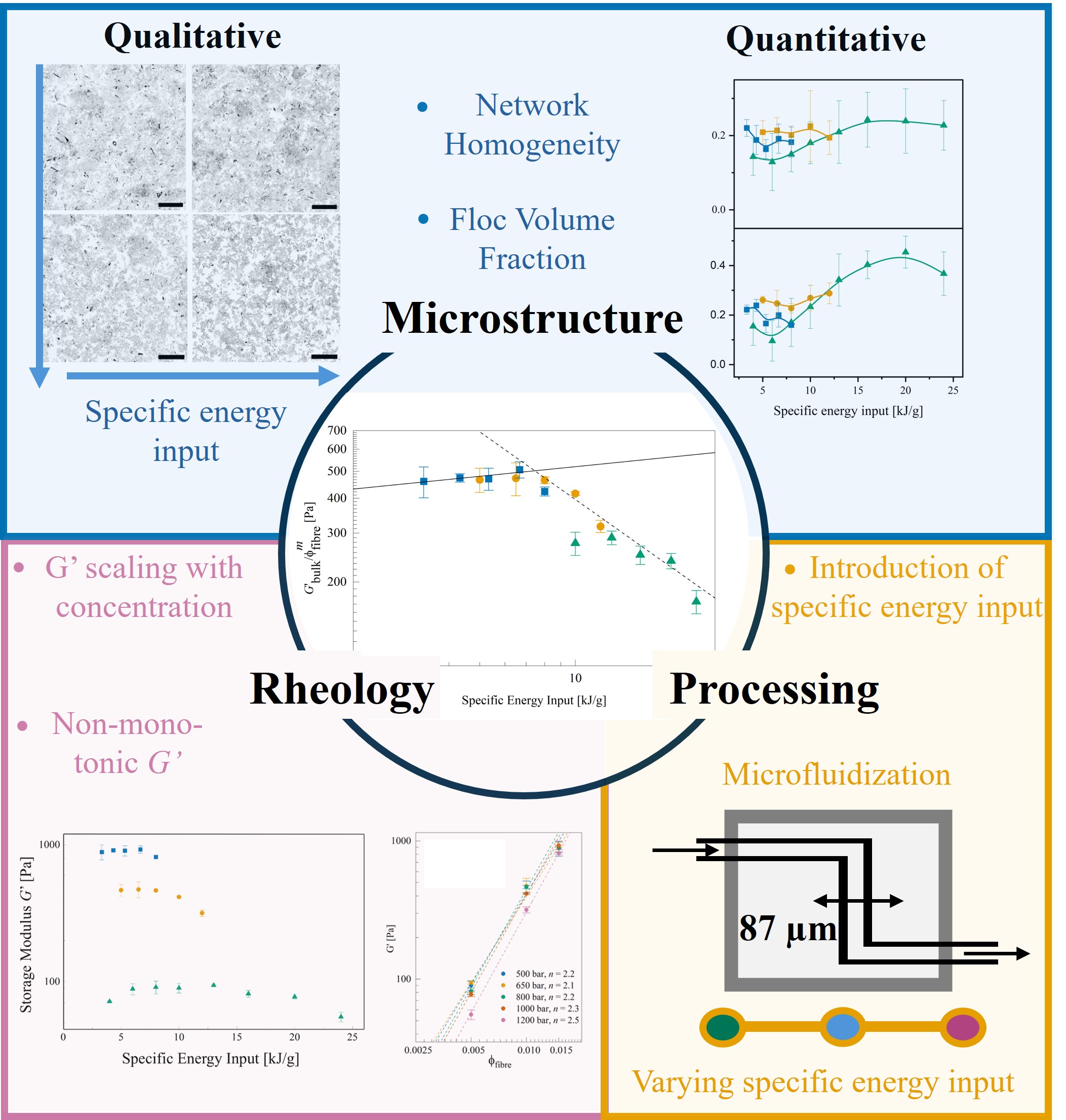
Within the CoCoGeL MSCA Network, researchers explored how microfluidization influences the structure and mechanical response of citrus fibre dispersions. In a recent Food Hydrocolloids publication, Lennard Schulte and Krassimir Velikov examine how specific energy input during processing relates to the formation and properties of cellulose microfibril networks. 🔬
By combining confocal microscopy and oscillatory rheology, the study shows that changes in specific energy input are closely associated with systematic changes in network microstructure and elasticity. Moderate energy inputs are linked to network strengthening, while higher inputs correlate with reduced elasticity. When scaled appropriately, results across different fibre concentrations collapse onto a single master curve, pointing to distinct processing regimes.
Why does this matter? Citrus fibre is a sustainable, clean‑label ingredient, yet its functional behaviour can be difficult to tune and predict. This work contributes a mechanistic, process‑based framework for relating microfluidization conditions to material properties, supporting more informed texture design through processing rather than formulation changes. The insights may also be relevant beyond food, for other plant‑fibre‑based systems. 💡
This project is funded from the European Union’s Horizon Europe Framework Programme (HORIZON) under the Marie Skłodowska-Curie Grant Agreement (GA) Nº: 101120301.
Full paper in Food Hydrocolloids, https://doi.org/10.1016/j.foodhyd.2026.112541
#CoCoGeL #Rheology #CSLM #Cellulose #CitrusFibre #MSCA_DN_ID