Aoxuan Wang, Fabrice Toussaint, Thomas Gibaud
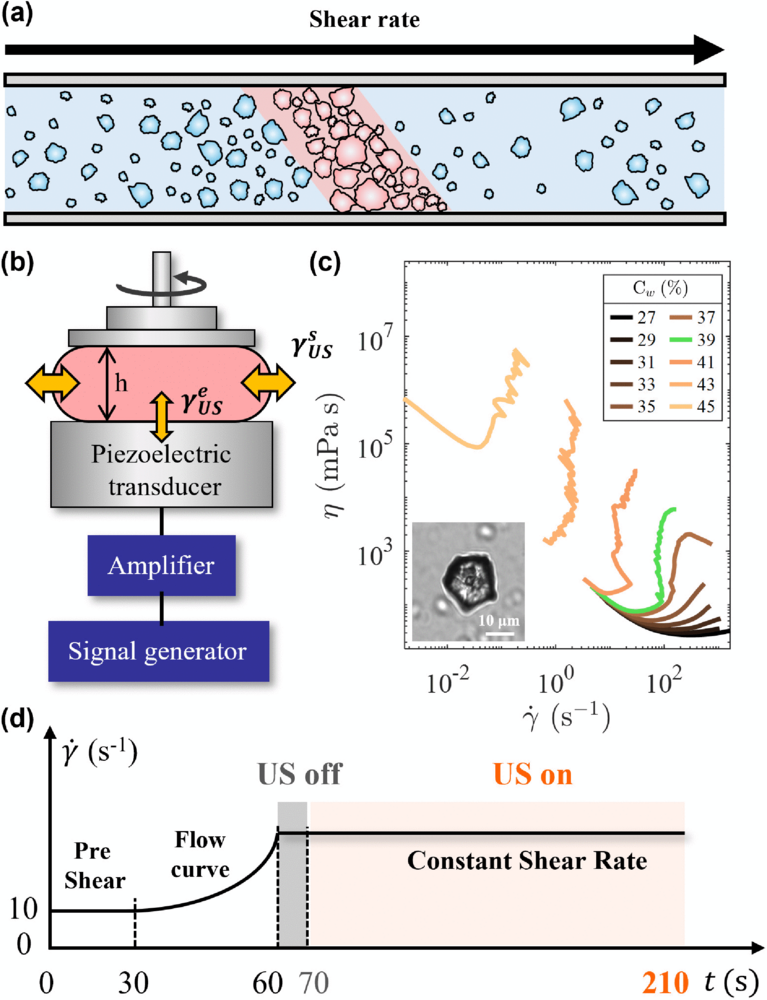
Discontinuous shear thickening (DST) in dense suspensions leads to flow instabilities that limit processing in a wide range of industrial and natural systems. Although high-power ultrasound has long been known to fluidize these materials, the physical origin of this effect remains unclear. Here, we investigate adhesive cornstarch suspensions, in which DST emerges from fragile load-bearing force networks embedded within heterogeneous density-wave structures. Using a rheo-ultrasound setup, where high-power ultrasound is superimposed onto a constant shear-rate flow, we demonstrate that ultrasound does not suppress shear thickening but continuously shifts the DST transition toward higher shear rates, thereby reducing the apparent viscosity. This shift is evidenced by the collapse of stress probability distributions measured at different ultrasound amplitudes onto master curves, revealing a renormalization of the shear thickening transition. We interpret these results within a separation-of-timescales framework. Because the acoustic oscillation period is much shorter than the characteristic timescale of suspension restructuring, the suspension structure can be considered quasistatic on the acoustic timescale, while ultrasound generates high-frequency oscillatory interstitial flows that perturb the local hydrodynamic stresses within the force-network structure. Guided by scaling analysis and estimates of the relevant physical stresses and timescales, we show that several microscopic mechanisms—including ultrasound-induced boundary slip, localized acoustic streaming, and pore-scale hydrodynamic fluctuations that destabilize force networks—are compatible with the observed experimental results. These findings provide a physical framework for understanding acoustic control of shear thickening in adhesive dense suspensions and establish ultrasound as a promising strategy for controlling discontinuous shear thickening and associated flow instabilities.
The article: https://journals.aps.org/prmaterials/abstract/10.1103/y25x-dm5s